Deep Tissue Massage at Home in London
Deep tissue massage at home means slow, firm pressure on the knots and tight spots that a relaxation massage glides over, without a journey across London afterwards while your muscles are still tender. We send a qualified, DBS-checked therapist, male or female as you prefer, to homes and hotel rooms in every London borough at any hour, with a professional table and everything else the treatment needs. Sessions last 60, 90 or 120 minutes and start at £99, travel included. It is part of our home and mobile massage service.
- Open 24 hours, 7 days a week
- Qualified, DBS-checked therapists
- Travel across London included
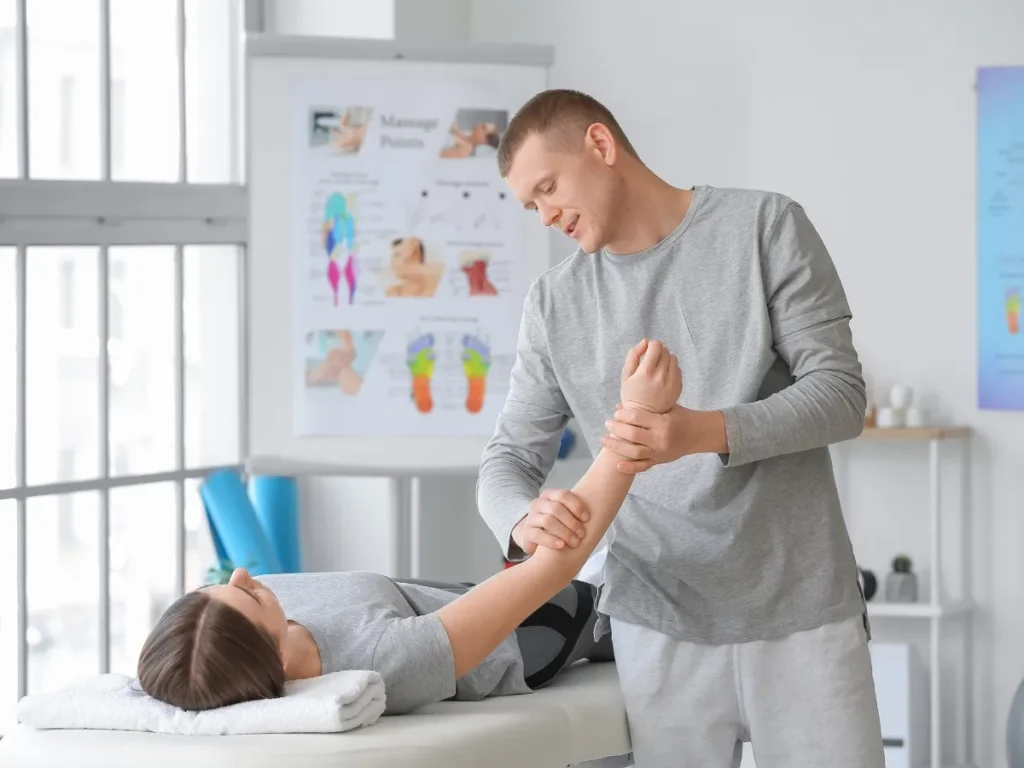
Deep tissue in brief
- Pressure
- Firm to very firm, always within your limit
- Focus
- One to three tight areas, rather than the whole body evenly
- Session lengths
- 60, 90 or 120 minutes
- Price
- £99, £149 or £199, travel included
- Afterwards
- Some tenderness for a day or two is common
- Not suitable
- With blood clots, blood thinners, osteoporosis, recent surgery or a new injury, unless cleared
- Availability
- Any hour, any London borough
- Therapists
- ITEC, VTCT and CThA-qualified, DBS-checked
What Is Deep Tissue Massage?
Deep tissue massage is a slow, focused massage that works through the surface muscles into the deeper layers beneath them and into the fascia, the connective tissue that wraps every muscle. It is sometimes called structural massage. Where a Swedish massage covers the whole body at an even pace, a deep tissue session spends most of its time on the few areas that feel stiff, knotted or restricted.
It is not simply a Swedish massage done harder. The strokes are slower so the tissue has time to soften under pressure, the contact points are smaller and firmer, and the therapist works along and across individual muscles rather than sweeping over whole areas.
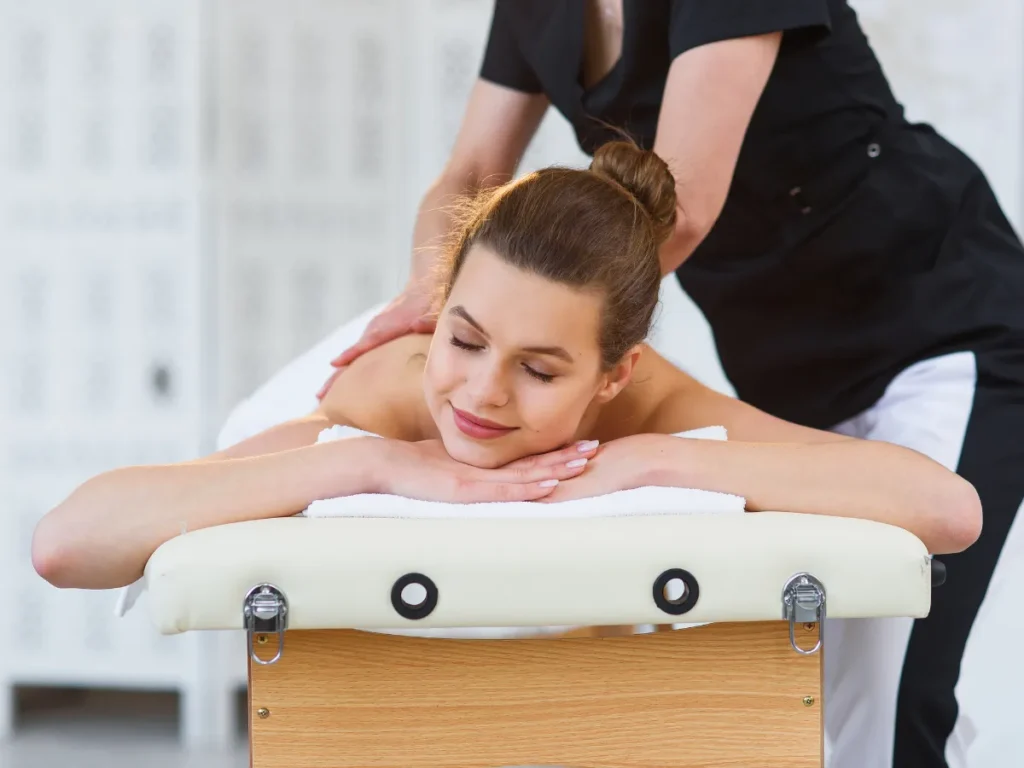
Deep Tissue Techniques
| Technique | How it is done | Typical areas |
|---|---|---|
| Forearm gliding | Broad, slow strokes with the forearm to warm and spread pressure | Back, thighs, calves |
| Stripping | Slow, gliding pressure along the length of one muscle with a thumb, knuckle or elbow | Upper back, hamstrings, calves |
| Cross-fibre friction | Firm strokes across the direction of the muscle fibres | Around the shoulder blades, along the spine |
| Sustained compression | Steady pressure held on a tender spot, a knot or trigger point, until it begins to ease | Upper shoulders, neck, glutes |
Your therapist builds up to these gradually. The first part of every session uses lighter, broader strokes so the muscles are warm before any deep work begins.
What the Research Says
Deep tissue massage has been tested in clinical trials, mostly for back pain. The results are encouraging but more nuanced than most massage websites admit.
Deep tissue massage and painkillers
A 2014 randomised trial of 59 adults with chronic low back pain compared deep tissue massage alone with deep tissue massage plus anti-inflammatory painkillers (NSAIDs) over two weeks. Pain and disability scores improved in both groups, with no significant difference between them (ScientificWorldJournal, via PubMed).
Deeper is not automatically better
A 2011 trial of 401 adults with chronic low back pain, published in the Annals of Internal Medicine, compared structural (deep) massage, relaxation massage and usual care. Both massage groups improved function more than usual care after 10 weeks, and there was no meaningful difference between the deep and the relaxation massage (Cherkin et al., 2011).
The wider picture
The US National Center for Complementary and Integrative Health rates the overall evidence for massage and low back pain as weak, with short-term relief more likely than lasting change (NCCIH).
What this means in practice: choose deep tissue massage because you prefer firm pressure, not because harder massage is guaranteed to work better. We never push pressure beyond what feels right to you, and if you have ongoing pain, a GP or physiotherapist should assess it first.
Who Deep Tissue Massage Suits
Deep tissue massage is the right choice if you:
Work at a desk
Work at a desk and carry stiffness between the shoulder blades, in the neck or in the lower back;
Do physical work
Do physical work, such as trades, hospitality or nursing, and feel it in specific muscles by the end of the week;
Lift, run or cycle
Lift, run or cycle and enjoy firm work on the muscles you load most;
Find Swedish massage too light
Find Swedish massage too light and come away feeling nothing has changed;
Like to know the session is focused
Like to know the session is focused on the areas that bother you rather than spread evenly.
If you are preparing for an event or recovering from a race, mobile sports massage is built for that. If you simply want to switch off, Swedish massage at home is the better fit.
Safety: When Deep Tissue Massage Is Not Right
Serious problems from massage are rare, but the NCCIH notes that the reported cases mostly involved vigorous techniques such as deep tissue massage, or people at higher risk of injury. That is why we ask more health questions before a deep tissue session than before any other treatment.
Please tell us at booking if you have:
- a history of blood clots or deep vein thrombosis, or take blood-thinning medication;
- osteoporosis or any condition that weakens the bones;
- had surgery, a fracture or a new injury in recent weeks;
- varicose veins, a bleeding disorder, or bruise very easily;
- diabetes affecting the feet or legs, or reduced feeling anywhere;
- active cancer treatment;
- a pregnancy.
Depending on your answer, your therapist will lighten the pressure, avoid an area, suggest a gentler treatment, or ask you to get the go-ahead from your GP first.
Does Deep Tissue Massage Hurt?
It should feel strong, not painful. A useful guide is a pressure scale from 1 to 10: aim for around 6 or 7, where the pressure is intense but you can still breathe slowly and stay relaxed. If you find yourself holding your breath, tensing up or wincing, the pressure is too high, and tensing against it makes deep work less effective.
Speak up at any point. Your therapist will check in during the first deep strokes and adjust from there.
Your Deep Tissue Massage at Home, Step by Step
Booking
Message +44 7460 672100 on WhatsApp at any hour, pick your session length and therapist, and pay in full to secure the slot.
Set-up
Your therapist arrives with an Earthlite portable table, fresh linen, towels and products, and sets up in whichever room has space.
Detailed consultation
Where it hurts or feels tight, what makes it worse, any injuries, medication or conditions, and how firm you want the pressure.
Warm-up
Lighter, broader strokes over the areas to be treated, until the muscles are warm.
Focused work
Slow, deep techniques on your priority areas, with regular pressure checks.
Finish
Lighter strokes to settle the muscles, then your therapist packs away while you rest.
Aftercare: The Next 48 Hours
Expect some tenderness
A day or two of soreness, similar to the feeling after a hard workout, is common and fades on its own.
Keep moving gently
A short walk or light stretching helps more than staying completely still.
Warm, not hot
A warm shower or bath can feel good; avoid very hot baths if you feel light-headed.
Drink water and eat normally
There is no need for anything special.
Skip heavy training the same day
Give the worked muscles a day before loading them hard.
If an area feels sharply painful, swells, or bruises badly, or soreness lasts more than a few days, contact us and, if needed, your GP.
Choosing Your Session Length
| Length | What fits | Best for |
|---|---|---|
| 60 minutes | Warm-up plus deep work on one or two areas, such as neck and shoulders | A single problem area |
| 90 minutes | Back, neck, shoulders and legs without rushing | Most clients |
| 120 minutes | Deep work across the whole body, with time to return to stubborn spots | Physically demanding weeks |
Deep work cannot be hurried; the tissue needs time to soften. If you have several tight areas, 90 minutes gives a noticeably more thorough session than 60.
Oil or Cream for Deep Tissue Work?
Many therapists prefer cream for deep tissue massage because it gives more grip, which helps with slow, precise strokes. We use Augustinus Bader The Body Cream and Elemis Pro-Collagen Marine Body Cream, or Les Exclusifs de Chanel body oil if you prefer the feel of oil. Tell us about any nut or skin allergies when you book; the Elemis cream contains sweet almond oil.
Deep Tissue Compared With Other Treatments
| Deep tissue | Sports | Swedish | Hot oil | |
|---|---|---|---|---|
| Pressure | Firm to very firm | Medium to firm | Light to medium | Gentle to firm |
| Built around | Chronic tight spots | Your training and events | Whole-body relaxation | Warmth |
| Stretching | Rarely | Yes | No | No |
| Feels like | Intense but productive | Brisk and targeted | Soothing | Comforting |
| Choose it if | Knots won't shift | You train or compete | You want to unwind | You want firm work with warmth |
Why Have Deep Tissue Massage at Home?
Deep tissue massage leaves muscles tender, and that is exactly when a commute is least welcome. At home, you can lie down straight away, take a warm shower and sleep, rather than sitting on a train or behind a wheel with stiffening muscles. It also means a full consultation in private, which matters when you are describing injuries or medical history.
Prices for Deep Tissue Massage at Home
| Session | Price |
|---|---|
| 60 minutes | £99 |
| 90 minutes | £149 |
| 120 minutes | £199 |
Prices cover travel anywhere in London, the table, products, linen and towels. Pay by Visa, Mastercard, Apple Pay or Google Pay. Full payment secures your booking, and you can cancel or reschedule free of charge up to 12 hours before your appointment (cancellation policy).
Where We Bring Deep Tissue Massage
We bring deep tissue massage to homes, hotels and serviced apartments in every London borough. For local details, see our guides to mobile massage in Central London, North London, East London, South East London, South West London and West London.
Deep Tissue Massage FAQs
Is deep tissue massage better than Swedish massage for back pain?
Not necessarily. In the largest trial comparing them, deep and relaxation massage produced similar improvements in chronic back pain. Choose the pressure you enjoy; for persistent pain, see a GP or physiotherapist first.
How often should I book a deep tissue massage?
It depends on how quickly tension returns. Some clients book every few weeks during busy periods; others book only when an area tightens up. Leave at least a few days between sessions so any soreness can settle.
Can I have a deep tissue massage after a workout?
Yes, once you have cooled down and rehydrated. For recovery built around training and events, a sports massage is the more specific choice.
Will I bruise?
Most people do not. Bruising is more likely if you bruise easily or take blood thinners, which is why we ask about both before booking.
Is deep tissue the same as sports massage?
No. Deep tissue focuses on long-standing tightness wherever it is. Sports massage is organised around your sport, often includes assisted stretching, and changes depending on whether it is before or after an event.
Can I book a deep tissue massage tonight?
Yes. Message us whenever suits you, and we will tell you in the chat how soon a therapist can be with you, before taking payment.
Related Treatments
Firm work plus stretching, organised around training.
Deep pressure with the comfort of warmed oil.
The gentle, whole-body alternative.
Clothed, stretch-led work for stiffness.
See every treatment side by side on our massage services and prices page.
Book a Deep Tissue Massage at Home
Message +44 7460 672100 on WhatsApp at any hour, or contact us with a question about your treatment. If you have a medical condition, mention it when you book so we can advise before you pay.